
Stand-Up Pouch, Spout Pouch, or Zipper Pouch: Which Is More Cost-Effective?
When choosing custom flexible packaging, many buyers compare prices by asking:
Which pouch is cheaper?
But pouch cost is closely related to its structure and function.
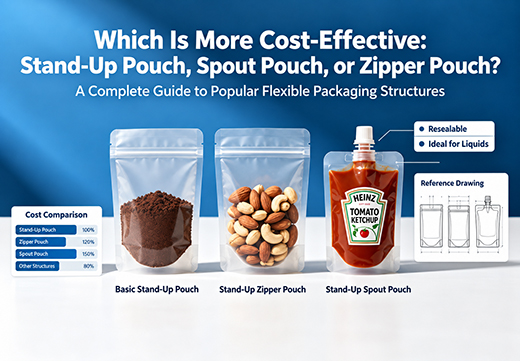
A simple three-side seal pouch costs less to manufacture than a stand-up pouch. Adding a zipper increases the cost again. Adding a spout and cap requires additional materials and converting processes.
So the most cost-effective pouch is not necessarily the one with the lowest unit price.
A better principle is:
Use the lowest-cost structure that still provides the functions your product really needs.
Why Do Different Pouch Styles Cost Differently?
The more complex the pouch structure, the more converting steps and materials are normally required.
A three-side seal pouch is one of the simplest structures. It has good material utilization and relatively low converting cost, making it suitable for many lightweight products that only need basic protection.
A four-side seal pouch requires additional sealing and slightly more material, but provides stronger sealing and is often used for powders, liquids, or products requiring higher protection.
A stand-up pouch adds a bottom gusset so the package can stand on the shelf.
A spout pouch adds not only the standing structure, but also the spout, cap, and spout-insertion process.
A zipper pouch adds a resealable closure.
Every additional feature has a cost.
The important question is whether that feature creates enough value for the product and the customer.
Stand-Up Pouch: Pay More When Shelf Presentation Matters
Compared with a simple flat pouch, a stand-up pouch normally costs more because of the bottom gusset and additional converting process.
But what you are really paying for is the ability to stand upright.
This can be valuable for products sold on retail shelves because it provides:
Better product presentation
More visible branding area
More convenient storage after purchase
For snacks, nuts, pet treats, coffee, powders, and many other retail products, this additional cost may be worthwhile.
However, if the product does not need to stand, paying extra for the gusset may provide little practical value.
Choosing a stand-up pouch simply because it looks more premium is not always the most economical decision.
Spout Pouch: Higher Cost Should Be Justified by Convenience
Spout pouches are commonly used for liquids and semi-liquids such as:
Juice
Sauces
Purees
Detergents
Personal-care products
The spout allows the customer to pour the product and close the package again.
This convenience comes with additional cost.
According to the reference structure, a stand-up or spout pouch may cost approximately 20–30% more than a basic three-side seal pouch in comparable applications, although the actual difference will depend on size, material, quantity, printing, and fitment specifications.
If the product genuinely needs controlled pouring and resealing, that additional cost is reasonable.
But the spout size also needs to match the product.
For relatively free-flowing liquids, an inner diameter of around 8 mm or larger may work well.
For thicker products or products containing particles, a larger opening—around 12 mm or more in some applications—may be necessary.
Choosing a smaller spout simply because it costs slightly less can make the product difficult to dispense.
Saving a small amount on packaging while creating a poor user experience is not a real saving.
Zipper Pouch: The Cost Depends on How Important Resealing Is
Adding a zipper can increase the cost of a pouch by roughly 20% compared with a similar pouch without one, depending on specifications.
For a single-use product, that extra cost may not be necessary.
But for products that are consumed over several occasions, a zipper can provide real value.
Examples include:
Nuts
Dried fruit
Jerky
Pet treats
Coffee
Tea
Powders
Customers can open the package, take what they need, and reseal it.
The frequency of use also matters.
If the pouch will only be opened a few times, a standard zipper may be sufficient.
If it is a large pet food or snack pouch that may be opened every day, zipper durability becomes more important.
The reference article recommends paying attention to the zipper profile and suggests that a tooth pitch of around 2 mm or more can be considered for applications requiring repeated opening.
The key is not simply whether the pouch has a zipper.
It is whether the zipper performance matches how the customer will actually use the package.
Three Common Ways to Spend More—or Save in the Wrong Place
1. Choosing Extra Functions Only Because They Look Better
A basic product does not automatically need a stand-up pouch, spout, and zipper.
Every feature should solve a real problem.
If customers do not need the package to stand, pour, or reseal, removing unnecessary functions can reduce cost immediately.
2. Choosing the Wrong Spout Size to Save a Small Amount
A small difference in spout cost is much less important than whether the product can flow through it properly.
The spout should be selected according to the viscosity, particle size, and dispensing requirements of the product.
3. Using a Low-Cost Zipper for a High-Frequency Application
A zipper that works well for occasional use may not be suitable for a pouch opened and closed repeatedly.
If the zipper stops working before the product is finished, the small initial saving has created a packaging problem.
Material and Thickness Matter Too
Pouch style is not the only factor affecting cost.
Material structure and thickness are equally important.
The reference article gives examples such as:
PET/CPP for some lightweight three-side seal applications
PET/AL/PE when stronger barrier protection is required
BOPP/CPP or PET/PE for some stand-up and spout pouch applications
These are useful starting points, but they should not be treated as fixed formulas.
The correct structure depends on:
Product weight
Moisture and oxygen sensitivity
Oil content
Puncture risk
Required shelf life
Filling and sealing conditions
Transportation requirements
Reducing thickness can lower material cost, but only after the pouch still meets the required performance.
A pouch that fails during filling, sealing, or transportation is never the cheapest solution.
So Which Pouch Is More Cost-Effective?
There is no single pouch that is cheapest for every product.
The practical comparison is:
Three-side seal pouch: usually the lowest-cost choice when only basic packaging is required.
Stand-up pouch: costs more, but the extra cost can be justified by better shelf presentation.
Spout pouch: costs more again, but makes sense when pouring and resealing are important.
Zipper pouch: adds cost, but is valuable when customers need to open and close the package repeatedly.
The goal is not to remove every feature to achieve the lowest quotation.
It is to identify which functions the customer really needs and avoid paying for the ones they do not.
That is how packaging cost should be optimized.
Need Help Comparing Pouch Costs?
Not sure whether your product really needs a stand-up structure, spout, or zipper?
Send us your product type, fill weight, pouch size, shelf-life requirement, and how the customer will use the package.
We can help compare pouch structures, materials, thicknesses, zippers, and spout options before you finalize the specification.
Website:
www.custompackagingprint.com
Email:
[email protected]
WhatsApp:
+86 173 3600 3921
 Stand-Up Pouch, Spout Pouch, or Zipper Pouch: Which Is More Cost-Effective?
 How Door-to-Door Shipping Makes Importing Custom Pouches from China Easier
 Can Canva Files Be Used for Custom Plastic Bag Printing?